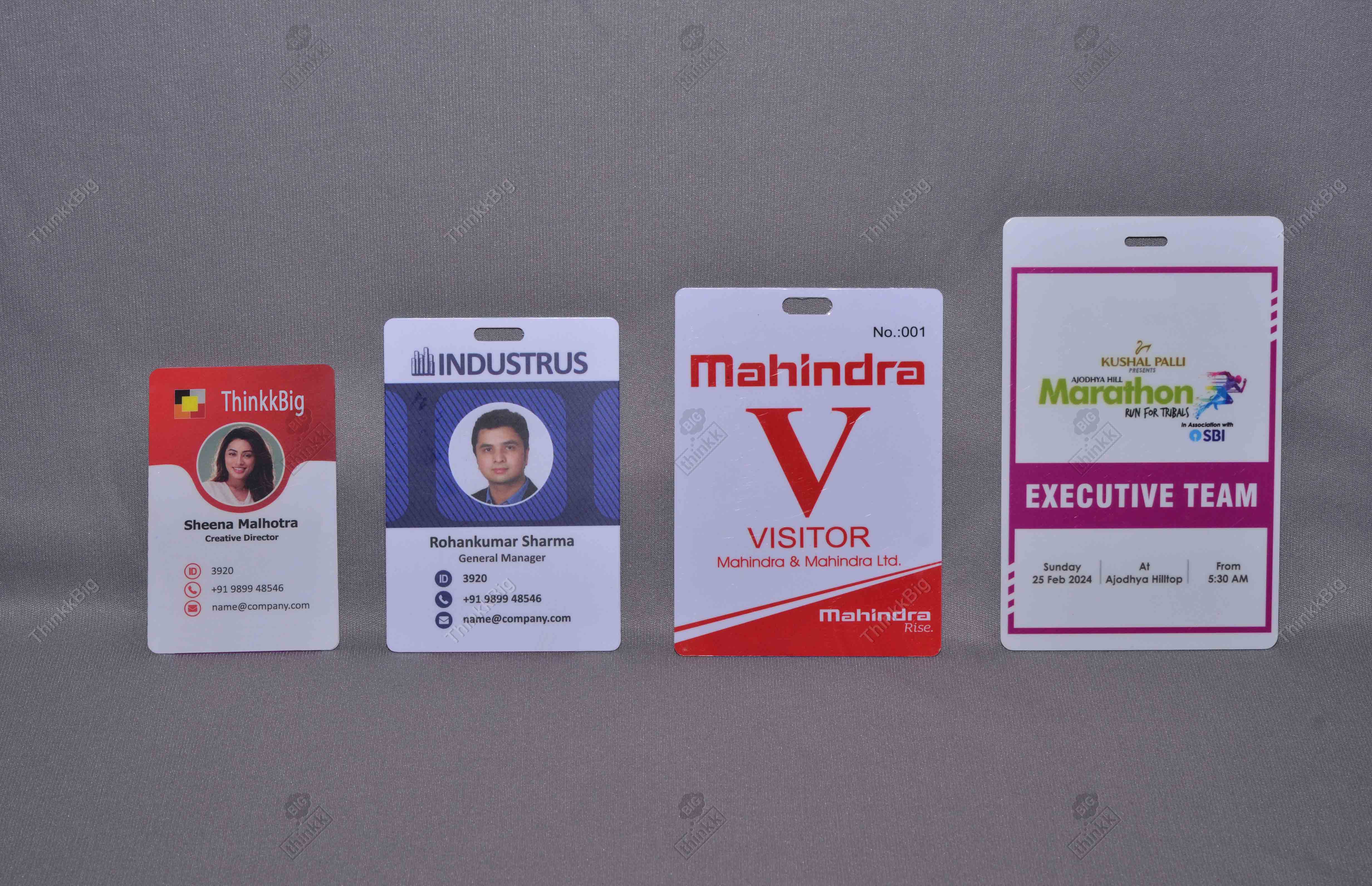
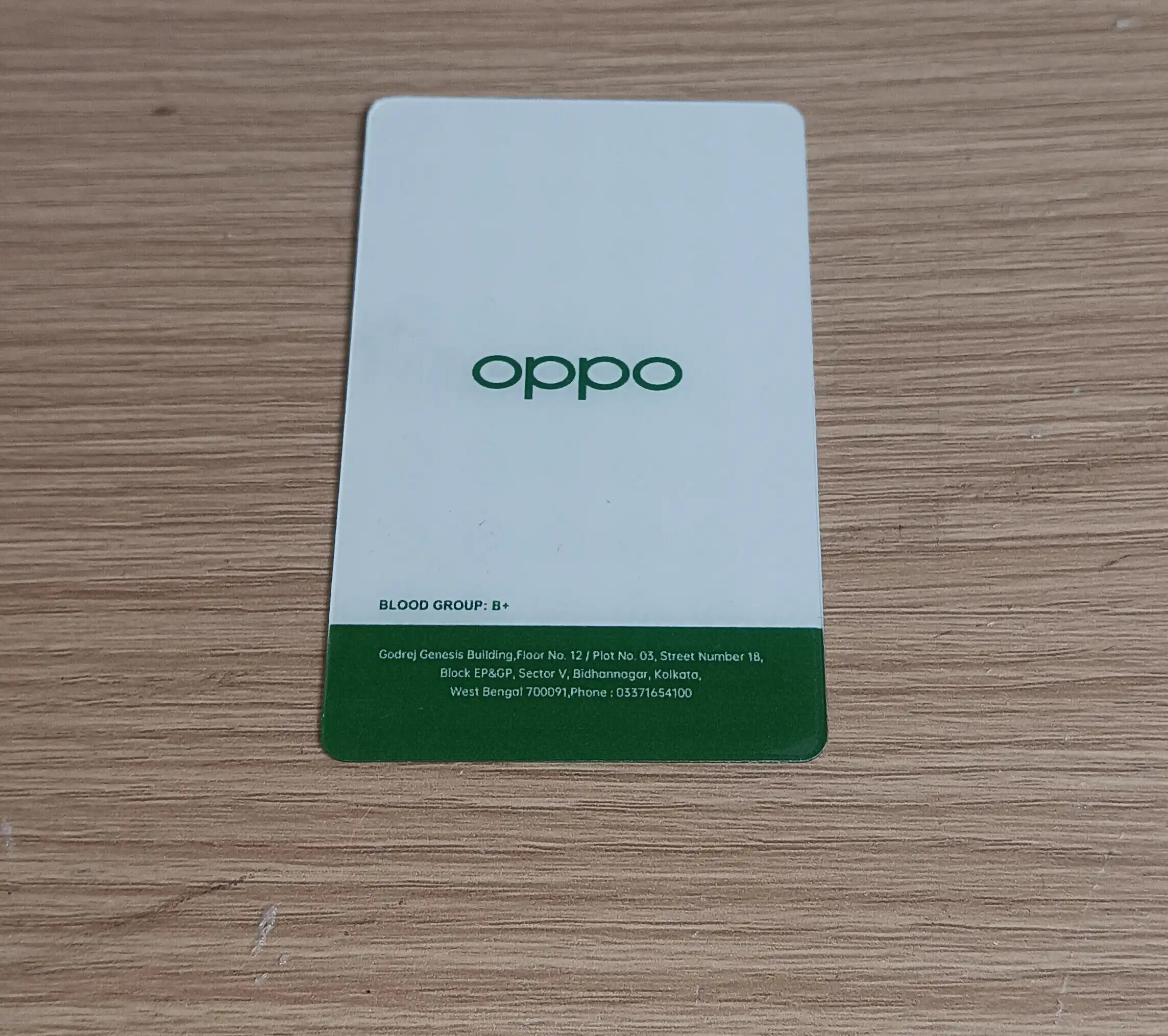
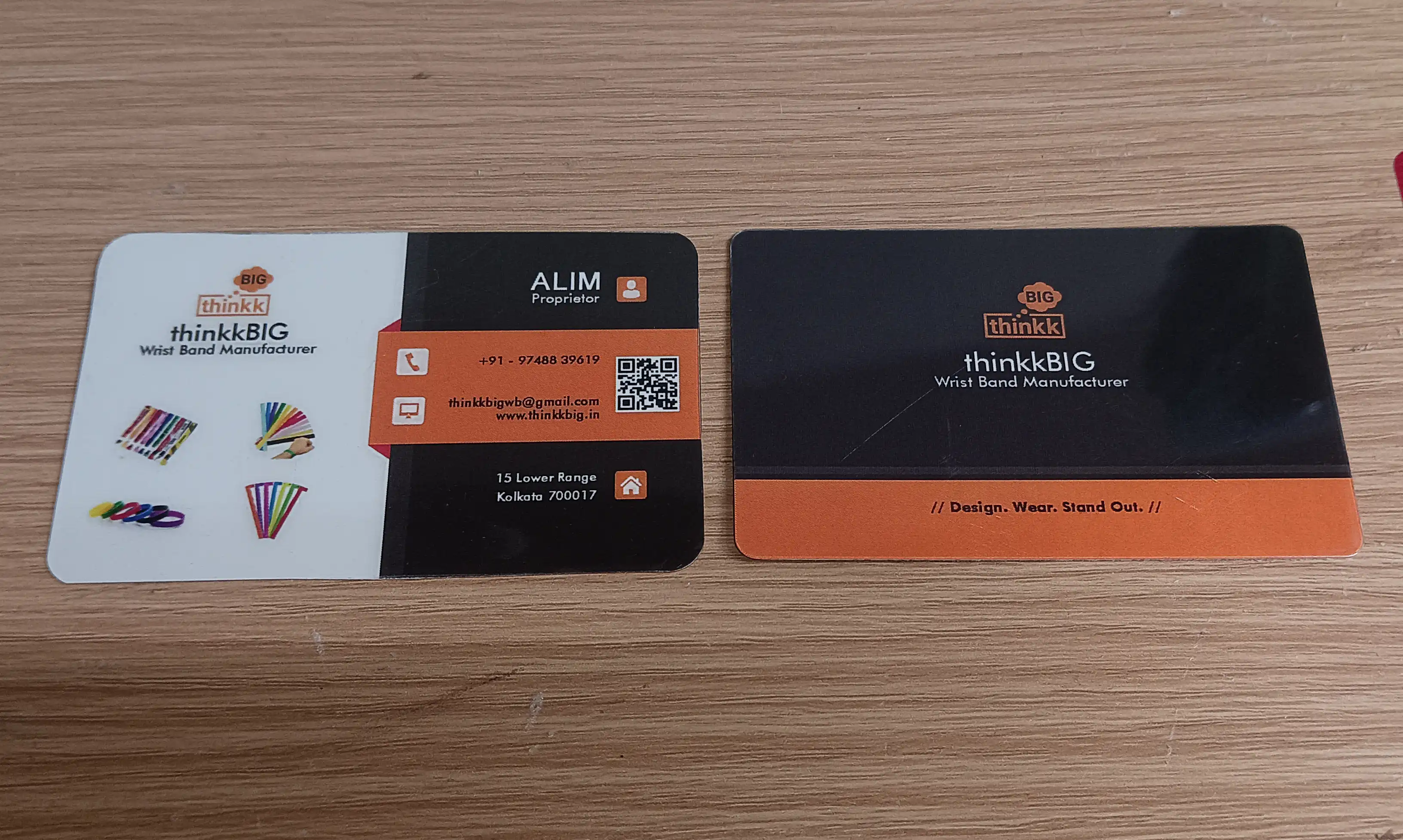
Non-tearable synthetic paper core. Heavy lamination. Precision die-cut to exact size. Two standard sizes — credit card and exhibition — with single or double-sided printing.
Unlike regular paper ID cards that tear, warp, and degrade, our cards are built on a plastic synthetic paper core — the same material used in long-lasting industrial documents. This is laminated on both sides with 350-micron lamination sheets, giving a rigid, durable, professional-grade finish that holds up through daily handling for years.
Pricing is quantity-based. WhatsApp us your size, quantity, single or double-sided, and attachment type (punch or holder). We'll quote and advise on design requirements. Free delivery always included.
The global standard ID card format — the same dimensions as a bank card, driving licence, or credit card. Fits every standard ID card holder, lanyard pouch, and wallet slot.
A larger format used at conferences, trade fairs, and events where the card needs to display more information or be readable from a short distance. Stands out around the neck.
The difference between a card that looks professional and one that feels it starts with the material and the process.
Regular paper ID cards absorb moisture, warp at the edges, and tear under sustained daily handling. Our non-tearable synthetic paper core is a plastic-based material that doesn't behave like paper at all — it doesn't tear, warp, or degrade. This is the foundation that makes everything else work.
Most ID card producers use guillotine cutting — a straight blade that leaves slightly imprecise edges and can cause corner cracking in laminates. We use dedicated die-punch machinery that cuts the card to exact dimensions in a single press. Every card in a batch is identical.
We design with bleed in mind — the extra artwork area beyond the card edge that prevents white borders after cutting. And we keep logos, text, and critical information within the safe margin zone so nothing gets clipped by the die. Most walk-in print shops don't do this. We do it as standard.
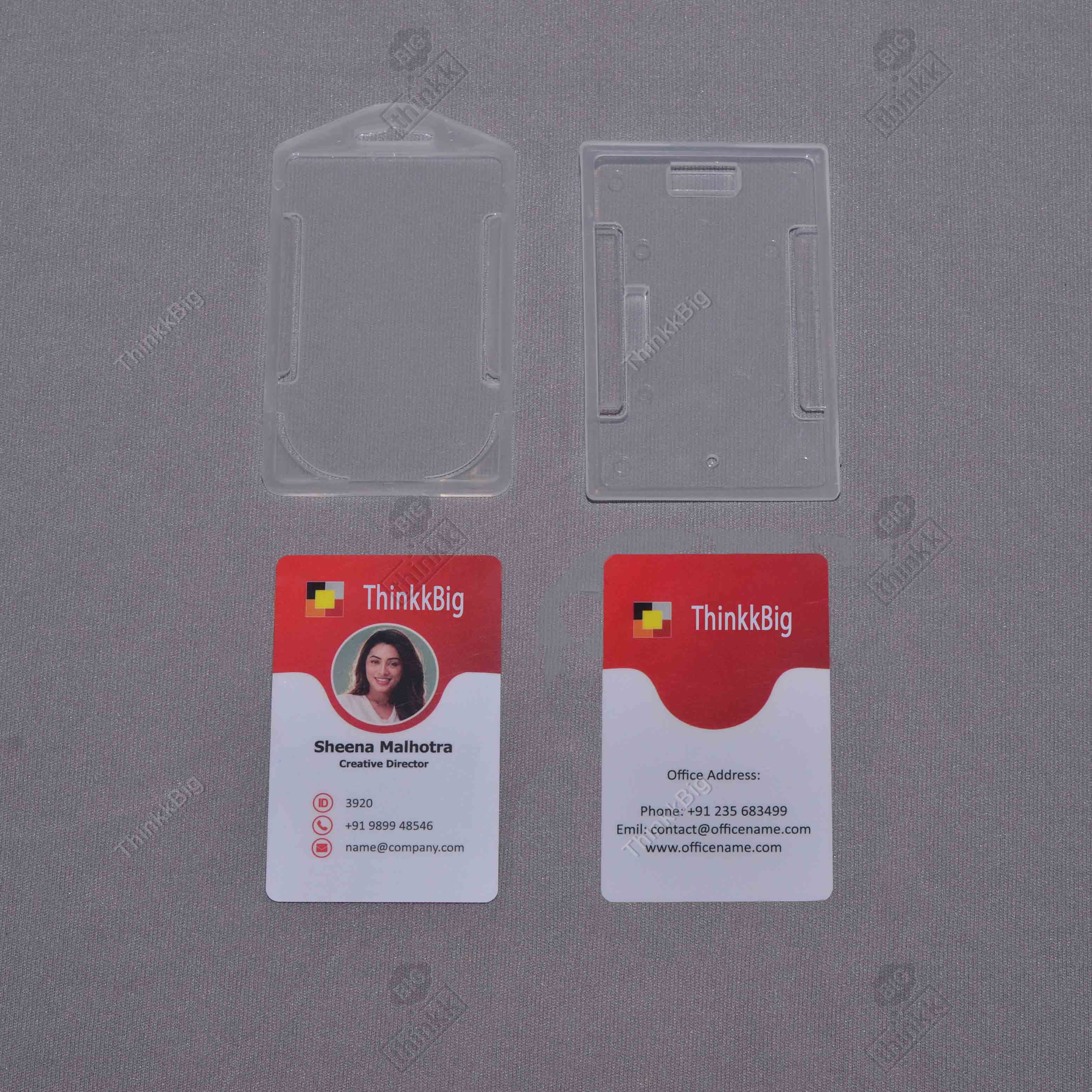
We offer a direct hole punch in the card itself (for a metal split ring or lanyard loop), or a slot punch for a clip holder. Both are clean and precise — no rough edges, no split laminate around the hole. We also supply ID card holders for both standard and exhibition sizes.
For double-sided cards, the reverse must correspond precisely with the front. A misaligned back — where the flip side doesn't line up correctly — is immediately obvious and looks poor. We accept double-sided jobs only when both sides are submitted together and checked for alignment before printing.
ID card design is genuinely more complex than wristband design. We are honest about this — we provide design assistance for volume orders where the brief is clear. For small test orders, we'll advise you on the file requirements and what to prepare.
Four stages, each with a specific quality standard that most ID card suppliers skip.
We review your design for bleed, safe margins, resolution, and colour mode. For double-sided cards, we verify front-back alignment. Any issues are flagged before anything goes to print.
Your design is printed directly onto the non-tearable synthetic paper stock using professional printing equipment. The synthetic surface gives sharper results than standard paper.
Both sides of the printed sheet are laminated with 350-micron lamination film — significantly heavier than standard lamination, giving the card its rigid, durable feel and protective outer layer.
Cards are cut to exact size using a dedicated die-punch. Where requested, the hole punch or slot punch is applied at the same stage — clean, precise, no rough edges.
| Core Material | Non-tearable synthetic paper (plastic-based — does not absorb moisture, warp, or tear) |
| Lamination | 350-micron lamination film applied to both sides |
| Size — Standard | 54mm × 86mm (credit card size, CR80 format) |
| Size — Exhibition | 85mm × 130mm (A6-adjacent conference size) |
| Cutting Method | Precision die-punch — exact dimensions, no guillotine variance |
| Print Sides | Single-sided or double-sided — specify at order time |
| Print Type | Full colour digital print |
| Attachment Options | Round hole punch (lanyard ring), slot punch (clip holder), or no punch |
| ID Holders | Available in standard and exhibition sizes — hard plastic, portrait and landscape |
| Design Requirements | Artwork must include bleed area. Safe margins required for all text and logos. See design section below. |
| Production Time | 4–6 working days after approved artwork (design review adds 1–2 days) |
| Delivery | Free pan-India, 2–5 working days |
Standard paper absorbs moisture from hands, wallets, and the environment — cards warp, edges fray, and the laminate eventually separates. Synthetic paper is dimensionally stable — it doesn't absorb moisture, doesn't warp, and the laminate bonds more reliably. The card you produce on day one looks the same after two years of daily use in a lanyard.
Standard office lamination is typically 80–125 microns. Our 350-micron film is significantly thicker — it provides a genuinely rigid card feel, a harder surface that resists scratching, and better protection for the print layer underneath. The result is a card that feels premium and holds up to sustained daily handling.
A guillotine blade cuts in a straight line — fine for paper, but laminated cards can develop micro-cracks at the cut edge over time, especially at corners. A die-punch applies pressure from a shaped die, giving a clean cut through both the laminate and the core simultaneously, with sealed edges and consistent corner radii on every card.
ID cards are more technically demanding than wristbands. These aren't optional guidelines — they're the difference between a card that prints correctly and one that doesn't. We review every file before print.
Bleed is the area of artwork that extends beyond the finished card size — typically 2–3mm on all sides. When the card is cut, the blade falls within this bleed zone, ensuring there are no white borders from minor cutting variance. If your design has colour or graphics running to the card edge, bleed is non-negotiable.
The safe margin is the zone inside the card border where all critical content — names, logos, QR codes, designations — must sit. Typically 4–5mm from the card edge. Anything outside this zone risks being clipped by the die. We check this in every file we receive.
For double-sided cards, both sides must be submitted together — not as two separate files to be combined later. The reverse image must be a mirror-correct flip of the front layout. We verify this alignment before printing. A misaligned double-sided card is immediately obvious when held up to light.
Send print-ready PDF or high-resolution image files (300 DPI minimum). Include bleed in the file. Fonts should be embedded or outlined. RGB colour mode is acceptable — we convert to CMYK for print and will flag any colour shift concerns before printing. WhatsApp us to discuss file requirements before you begin designing.
WhatsApp us before you design. We'll tell you the exact file requirements for your chosen size, single or double-sided, and attachment type — saving you the trouble of redesigning after the fact.
WhatsApp Before You DesignStaff ID cards for daily building access, visitor passes, and departmental identification. Credit card size for lanyard or wallet carry.
Student and staff identity cards. Library access, attendance management, campus security. Durable enough for a full academic year of daily handling.
Staff identification across wards and departments. Visitor passes. Waterproof surface resists disinfectant wiping in clinical environments.
Delegate, speaker, and press credentials. Exhibition size is popular for events where the card displays session schedules or access zones on the reverse.
Site access cards, contractor identification, safety zone credentials. The synthetic paper core handles the humidity and physical wear of industrial environments better than standard cards.
Exhibitor, staff, and VIP credentials for trade shows and large events. Exhibition size cards are the professional standard for these environments.
Staff ID, vendor identification, event coordinator credentials. The card's durability handles the handling and humidity of a hospitality environment.
Multi-zone access cards, security personnel identification, visitor management systems. Can include zone markings, colour coding, and QR/barcode printing.
For budget-sensitive requirements, we also produce simple paper ID cards inserted into a clear hard-plastic pouch — a much more affordable option. These are suitable for short-duration events, temporary visitor passes, and situations where the card doesn't need to last more than a few days. This is a simpler, faster product — not our primary offering, but available on request. Our speciality is the plastic synthetic card. If you're unsure which option suits your need, WhatsApp us and we'll advise honestly.
Tell us your size, quantity, single or double-sided, and what attachment you need. We'll advise on design requirements and quote you directly.
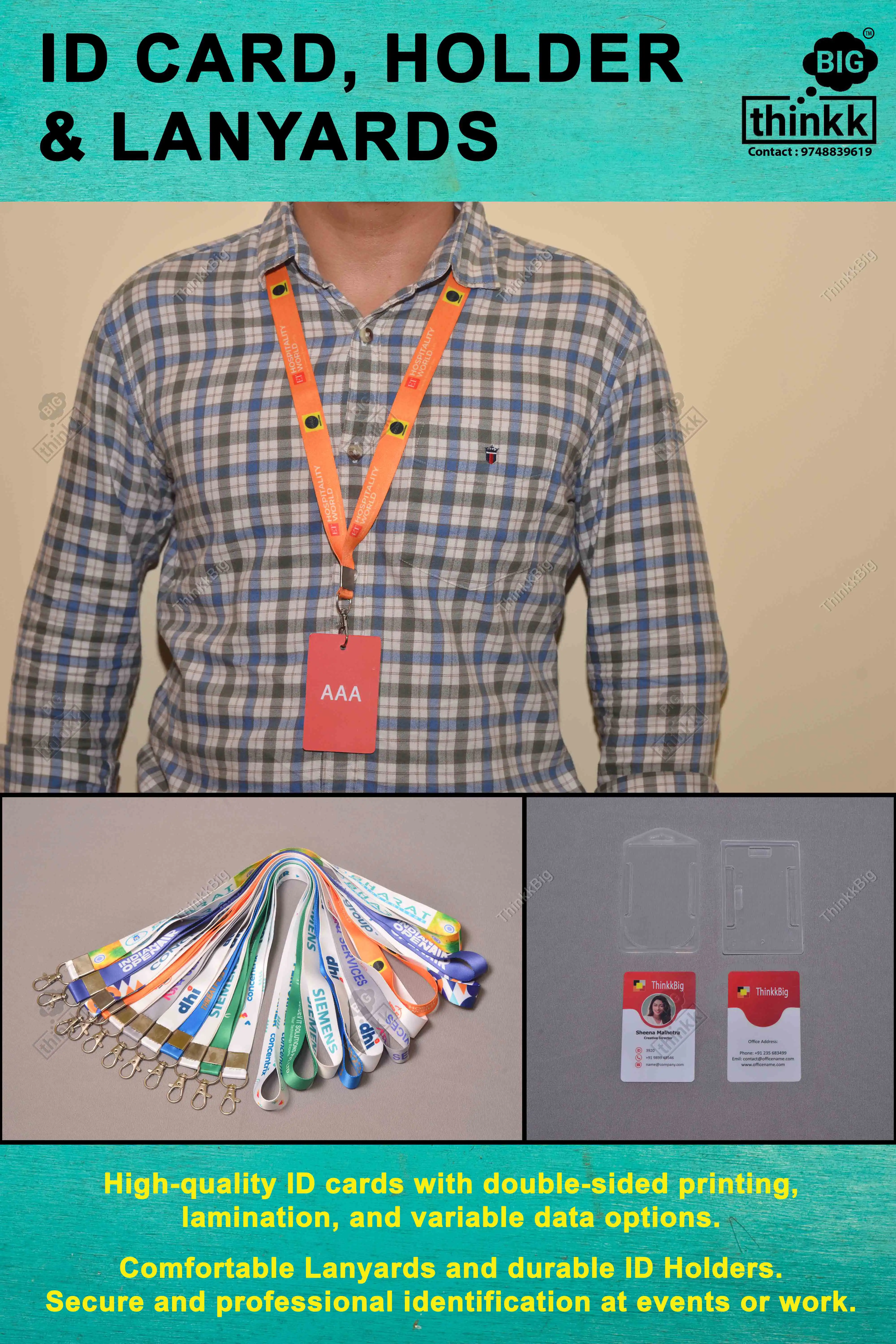
WhatsApp for Instant QuoteExport-quality cloth. Rust-resistant steel clamp and hook. Order lanyards and ID cards together as a complete set.
Pair ID cards for staff and crew with Tyvek wristbands for general event access control.
Same export cloth and rust-resistant hardware. Double-sided print. A branded giveaway to pair with corporate events.
For multi-day conferences: use ID cards for staff and exhibitors, fabric wristbands for delegate access control.
Non-tearable core. Precision die-cut. Professional finish. Free delivery across India.
WhatsApp +91 97488 39619